



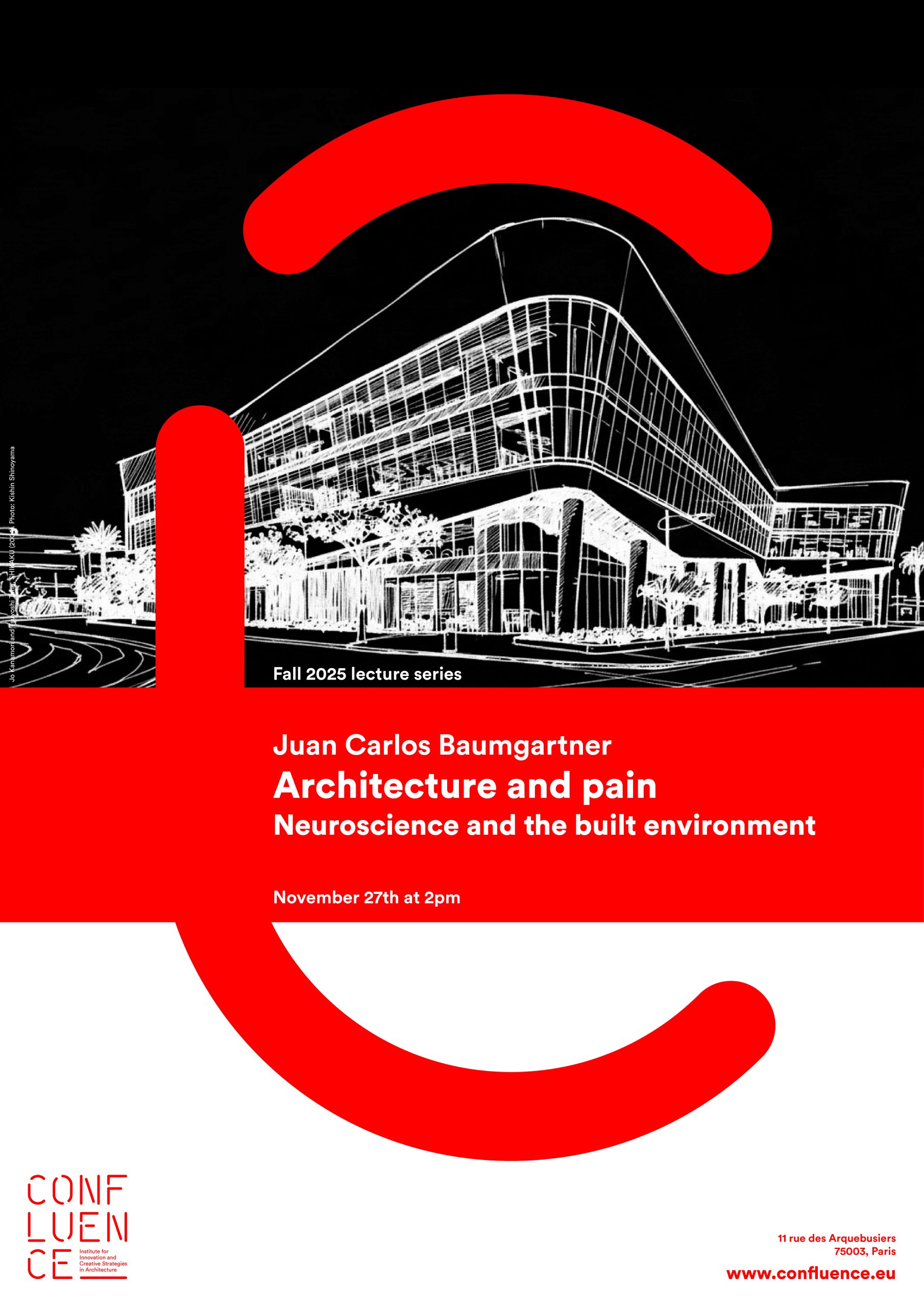
In recent years, neuroscience has revealed that the brain reuses the neural mechanisms of physical pain in many non-physical contexts —
from social exclusion to cognitive overload and even poorly designed environments. If we aspire to create architecture that is truly pleasurable, restorative, and human-centered, we must first ensure that we are not unconsciously activating the brain’s pain circuitry.
“Architecture and Pain” explores 3 non traditional sources of pain, the build environment can either trigger stress responses or promote wellbeing.
Through the lens of neuroarchitecture, this lecture examines the scientific evidence behind our sensory and emotional reactions to space, and proposes a design approach that minimizes neural “pain signals” while maximizing comfort, coherence, and cognitive ease.
Far from a theoretical discussion, this talk offers a practical framework: before designing for pleasure, we must design to avoid pain.
Juan Carlos Baumgartner is a Mexican architect and designer, trained in Mexico City, San Francisco, Chicago, Milan, and Venice.
He currently leads the international architecture firm Space, with offices in Mexico City, Monterrey, and Guadalajara, and a network of 15 associate studios across Latin America and Europe.
Founded 25 years ago, Space has become a benchmark in corporate design, hospitality, and educational environments throughout Mexico and Latin America. With projects in over 20 countries and more than 130 international design awards, the firm is recognized for blending innovation, research, and human-centric principles.
Recently, Space was ranked by the renowned INC Magazine as one of the 250 most innovative companies in the world, a recognition driven by its pioneering application of neuroscience and evidence-based research in architecture
With academic studies in neuroscience in Italy and Sweden, he is considered one of the pioneers of NeuroArchitecture, a discipline applying neuroscience to design. He currently collaborates with researchers around the world, driven by a singular vision: to create spaces that cultivate happiness—architecture capable of healing the soul.
