

In recent years, neuroscience has revealed that the brain reuses the neural mechanisms of physical pain in many non-physical contexts —
from social exclusion to cognitive overload and even poorly designed environments. If we aspire to create architecture that is truly pleasurable, restorative, and human-centered, we must first ensure that we are not unconsciously activating the brain’s pain circuitry.
“Architecture and Pain” explores 3 non traditional sources of pain, the build environment can either trigger stress responses or promote wellbeing.
Through the lens of neuroarchitecture, this lecture examines the scientific evidence behind our sensory and emotional reactions to space, and proposes a design approach that minimizes neural “pain signals” while maximizing comfort, coherence, and cognitive ease.
Far from a theoretical discussion, this talk offers a practical framework: before designing for pleasure, we must design to avoid pain.
Juan Carlos Baumgartner is a Mexican architect and designer, trained in Mexico City, San Francisco, Chicago, Milan, and Venice.
He currently leads the international architecture firm Space, with offices in Mexico City, Monterrey, and Guadalajara, and a network of 15 associate studios across Latin America and Europe.
Founded 25 years ago, Space has become a benchmark in corporate design, hospitality, and educational environments throughout Mexico and Latin America. With projects in over 20 countries and more than 130 international design awards, the firm is recognized for blending innovation, research, and human-centric principles.
Recently, Space was ranked by the renowned INC Magazine as one of the 250 most innovative companies in the world, a recognition driven by its pioneering application of neuroscience and evidence-based research in architecture
With academic studies in neuroscience in Italy and Sweden, he is considered one of the pioneers of NeuroArchitecture, a discipline applying neuroscience to design. He currently collaborates with researchers around the world, driven by a singular vision: to create spaces that cultivate happiness—architecture capable of healing the soul.
This intensive workshop offers an immersion into the work of Félix Candela, the architect-engineer whose thin concrete shell structures profoundly shaped twentieth-century architecture. Through the study of economical, structurally efficient, and spatially expressive forms, students examine the close relationship between geometry, material, and space.
The workshop combines theoretical investigation, physical experimentation, and digital exploration. Drawing on Candela’s principles—particularly the use of the hyperbolic paraboloid and the pursuit of material efficiency—students develop projects in which architecture is conceived in direct relation to structure and geometry.
Work alternates between physical models, casting, tensile structures, parametric modeling, and basic structural simulations. Students work in groups to produce a spatial project based on thin-shell logic. The workshop concludes with a public presentation and a collective discussion on the relevance of shell structures in contemporary architecture.
Architect and structural engineer, Pierre Marquis has worked in engineering offices in Germany and France, notably at Bollinger + Grohmann, and teaches at the École des Arts Décoratifs.
Engineer trained at École Polytechnique and École des Ponts & Chaussées, Koliann Mam specializes in complex timber and hybrid structures and conducts research on material environmental analysis. He teaches at École des Ponts and CHEB.
Architect and structural engineer, Laura Fontaine teaches at ENSA Marseille and edited the book L’Intelligence de la Forme on Félix Candela (Caryatide, 2025).
Félix Candela, writings and projects on thin reinforced concrete shells
Laura Fontaine (ed.), The Intelligence of Form – Félix Candela, Caryatide, 2025
This workshop examines pleasure in architecture as an active and critical condition of design, emerging from tensions between order and excess, use and event, body, space, and media. Pleasure is not treated as decorative surplus, but as a conceptual driver capable of structuring architectural thinking and production.
Through a close articulation of theoretical seminars and media experimentation, students explore multiple forms of pleasure—technological, spatial, embodied, controlled, and media-based—and analyze how these manifest in architectural projects, devices, and representations.
The workshop combines critical readings, film analysis, and architectural references with experimental sessions using tools of digital capture and representation. It equips students with intellectual and practical instruments to interrogate the role of pleasure in contemporary architectural design.
Aaron Sprecher is an architect and Professor at the Technion Faculty of Architecture and Town Planning, where he founded the Material Topology Research Laboratory (MTRL). He is also co-founder of Open Source Architecture, an international collaborative research practice. His work investigates the intersection of media theory, computational design, and digital fabrication through teaching, research, and practice.
Gilbert Simondon, “On Techno-Aesthetics”
Bernard Tschumi, “The Pleasure of Architecture”
Elizabeth Grosz, “Embodied Utopias: The Time of Architecture”
Mark Wigley, Untitled: The Housing of Gender
Sylvia Lavin, “Current Kisses”, in Kissing Architecture
A Forest RESONANCE Dream explores pleasure as a spatial, acoustic, and collective experience, questioning the presence of a foreign natural body within the city. The workshop imagines the forest not as vegetation alone, but as an expanded ecology of creatures, myth, folklore, and resonance. Inspired by William Shakespeare’s A Midsummer Night’s Dream, the project blurs the boundaries between reality and imagination, order and chaos, architecture and performance.
The workshop engages students in an experimental practice where architecture, sound, and storytelling converge. Drawing from Shakespeare’s text, students develop acoustic architectural creatures—resonant instruments, models, or performative devices exploring vibration, friction, echo, and noise. The work privileges instinct, rhythm, and improvisation over technical virtuosity.
The productions reference characters and situations from the play—metamorphosis, confusion, absurdity, naivety, illusion—and are shaped through materials selected for their acoustic qualities. Together they form a collective sound forest, activated through a final performance combining installation, narrative, gesture, and sound.
Ricardo de Ostos is an architect and educator whose work develops speculative fictions around architectures situated in urban forests and climate-affected environments. He is currently completing a Mangrove Museum and Ecological Learning Centre in Bangladesh. Born in Brazil, he lives and works in London, where he teaches at the Architectural Association and The Bartlett School of Architecture. He is co-director of the NaJa & deOstos studio and co-author of several books.
Instagram: @najadeostos
William Shakespeare, A Midsummer Night’s Dream
Ricardo de Ostos & NaJa, Scavengers and Other Creatures in Promised Lands, Architectural
Association, 2017
Ricardo de Ostos & NaJa, The Hanging Cemetery of Baghdad, Springer Wien / New York, 2006
The workshop Correspondances explores relationships between music and architecture through sensitive and graphic translation processes. By considering the musical score as an open creative tool, students investigate how drawing, diagrams, and writing can express time, rhythm, intensity, and emotion.
The work unfolds in two complementary phases. First, students produce an imaginary score based on listening to a musical piece, conceived as a subjective transcription of perceptions, mental images, and sensations. In the second phase, this score becomes the basis for the design of an imaginary architecture, where project quality depends on the relevance of the correspondences established between music and space.
The workshop emphasizes experimentation, interpretation, and invention over literal translation. It adopts a transdisciplinary approach in which architecture is understood as a language capable of resonating with other creative worlds.
Reza Azard is an architect and musician. A graduate of the École Nationale Supérieure d’Architecture de Paris-La Villette, he co-founded the studio Projectiles in 2005, a multi-award-winning practice working primarily on cultural and heritage projects. He has been teaching architecture for over twenty years and pursues an improvised music practice with the collective Gingembre Electric.
John Cage, musical scores and notations
Gingembre Electric, improvised music session
Join us in Paris on November 19th at 5pm !
Architect, researcher, performance-installation maker and educator Beth Weinstein investigates the field of archi-choreographic experiments in her monograph, Architecture + Choreography : Collaborations in Dance, Space and Time (Routledge 2024). The book’s forty case studies spanning four decades give evidence of the range of motivations for embarking on these creative endeavors and the diverse conceptual underpinnings, generative methods, objects of inquiry, and outcomes. Architecture and Choreography builds theories through which to examine these works and the contexts within and processes through which the works emerged, the critical questions they raise about ways to work together, sites and citations, ethics and equity, control and agency.
In her Confluence Institute lecture, she will present outcomes of her investigation into what emerges when architects and choreographers collaborate for the first time on the making of a spatial event, and particularly when they conceptually excavate sites or assemble spatial dispositives as generative methods. The talk will be followed by a Q&A and conversation about by sites and structures in the local context that invite exploration through archi-choreographic approaches.
An architect, researcher, performance-installation maker and educator, Beth Weinstein’s practice and research move between textual, material, spatial, performative, choreographic, and graphic modes to render sensible (dis)appearances and (in)visibilities related to critical issues such as climate catastrophe, historic injustices, states of exception, invisible labor, as well as creative processes.
She has synthesized nearly two decades of research on the field she calls archi-choreographic experiments in her monograph Architecture + Choreography: Collaborations in Dance, Space and Time (Routledge 2024) and previously curated the Collaborative Legacy of Merce Cunningham exhibition (2011-13). She has broadly published on performativity in and of public space, theater architecture, and scenography, including chapters in Performing Architectures (Methuen, 2018); Critical Practices in Architecture (Cambridge, 2020); The Routledge Companion to Scenography (Routledge, 2017); Architecture as a Performing Art(Ashgate, 2013); and Disappearing Stage (The Theater Institute, 2012); plus articles in the Journal of Architectural Education, the Journal of Artistic Research, Performance Research and Places.
Her current investigations, employing forensic architectural and other methods, focus on rendering sensible a razed space of internment in France—the Centre d’Identification de Vincennes. This has led her to co-found the international and interdisciplinary research group ReSI (Remembering Spaces of Internment).
Her work has been supported by the Graham Foundation (USA); FACE Foundation/Villa Albertine, Academie d’Architecture and Cité Internationale des Arts (F); Casa de Velazquez (E); Bundanon and Rosamund McCulloch/UTAS (AUS) residencies.
Beth Weinstein (BFA, M.Arch, PhD) is Professor of Architecture, Chair of Object and Spatial Design in the BA in Design Arts & Practices, and faculty affiliate of the School of Art, of the Social, Cultural, and Critical Theory GIDP (SCCT), and Arizona Institutes for Resilience (AIR) at the University of Arizona (UA). She has taught at ESA, ENSA Paris Malaquais and Confluence Inst. in France; in the US, at Columbia University GSAPP, Rensselaer Polytechnic Institute, Pratt Institute, and Parsons/The New School for Design.
Jo Kanamori and Tsuyoshi Tane, SHIKAKU (2004). Photo: Kishin Shinoyama
Intimate Connections explores the relationship between architecture and gustatory experience, questioning how space can extend, intensify, and transform the perception of taste. The workshop approaches architecture not as a purely functional framework, but as a sensitive device capable of acting on the body, the senses, and memory. Through a critical and experimental approach, students are invited to consider space as an active partner in the culinary experience.
The workshop proposes a cross-disciplinary reflection between architecture, gastronomy, and sensory design. Students analyze how materiality, light, acoustics, spatial rhythms, and scenographic devices influence taste perception and construct intimate experiences.
The work alternates between theoretical input, discussions, and practical experimentation. Students develop projects and micro-installations using various tools—drawing, writing, models, scenography, and photography—to imagine situations in which architecture becomes an extension of the act of eating. The workshop seeks to move beyond a compartmentalized vision of architecture and gastronomy, conceiving immersive experiences where space and flavor intertwine through a critical and sensitive approach.
Graduated from Confluence Institute in 2020, Ophélie Férédie developed a transversal background across art galleries, furniture design, floristry, and scenography before pursuing her architectural practice. This diversity informs an approach attentive to uses, atmospheres, and the relationships between objects, spaces, and bodies. She advocates for an understanding of architecture as an open discipline at the intersection of experience and emotion.
Emotional Artifacts explores light as an emotional and spatial language, beyond its purely technical dimension. The workshop invites students to consider light as a material capable of awakening memory, transforming the perception of time, and generating meaningful atmospheres. Through a sensitive and progressive approach, light becomes a vector of pleasure, emotion, and architectural experience.
Conceived as a five-day journey, the workshop unfolds through a continuous movement from perception to materialization: sensing, conceptualizing, and giving form. Students experiment with light in an intuitive and sensory way, observing daylight and nighttime conditions, reflecting on intimate experiences, and testing simple devices. The work culminates in the production of models conceived as emotional artifacts, condensing a personal vision of light as a source of joy and atmosphere.
Juan Velasquez is a light designer whose work explores light as a sensitive and expressive material, at the intersection of space, emotion, and lived experience. Through design and teaching, he develops an approach in which light is conceived as a language capable of revealing atmospheres and enriching architecture through poetic and sensory qualities.
Floating Paris approaches pleasure as an active driver of architectural action, directly engaging the city and the present moment. The workshop considers urban space not as a backdrop, but as a living milieu to be activated through temporary, lightweight, and performative interventions. Through the construction of ephemeral inflatable forms, students explore how architecture can structure and intensify the temporality of pleasure within the urban fabric.
The workshop develops an experimental and construction-based approach where learning emerges through action, testing, and in-situ experience. Working with lightweight, translucent, and temporary inflatable structures, students design spatial situations that question the relationship between pleasure, ephemerality, and everyday urban life.
Structured in successive phases—from model to form, from form to event, and from event to program—the workshop emphasizes full-scale (1:1) engagement, contextual adaptation, and the capacity to act here and now. Interventions culminate in a video, GIF, or photographic series documenting the spatial and performative effects.
Davor Ereš is an architect and researcher, founder of Poligon Studio in Belgrade. His work operates at the intersection of architectural practice, teaching, and research, with a focus on learning through architecture and questions of contemporaneity. He has led numerous international workshops and is the author of the Serbian Pavilion exhibition at the 2025 Venice Architecture Biennale,
Unraveling: New Spaces.
Website: www.poligon.rs
Project: www.unraveling.rs Instagram: @unraveling.rs
Albert Lamorisse, The Red Balloon, 1956
Michel de Certeau, The Practice of Everyday Life, vol. 1, 1980
Andrew Silver, Bubbletecture: Inflatable Architecture and Design, 2019
William McLean & Pete Silver, Air Structures: Form + Technique, 2015
Frédéric Migayrou & Valentina Moimas (eds.), Aerodream, 2021
Join us in Paris on September 22nd at 5pm !
English architectural writer Michael Webb will present an illustrated lecture on recently completed European concert halls and opera houses. Large or small, each is designed to delight the eyes and ears. In these halls, architecture and music are fused in a harmonious, mutually reinforcing way. Michael is currently co-authoring a book on this subject with a music critic and has been exploring halls all over Europe and talking with architects and artistic directors.
The lecture will sketch the historic roots of these halls in court theaters and salons, their exponential growth in the 19thcentury, and the radical departures from convention of Hans Scharoun in Berlin and Alvar Aalto in Essen. Michael will explore a dozen 21st-century theaters that push the boundaries in their plans, material palette and civic role, bringing concert-goers and performers closer together, and broadening the audience for opera and classical music.
Examples will include Snohetta’s Oslo Opera, Jean Nouvel’s KKL in Lucerne, Renzo Piano’s Parco della Musica in Rome and Stavros Niarchos Cultural Center in Athens, Herzog & de Meuron’s Elbphilharmonie in Hamburg, Henning Larsen’s Harpa in Reykjavik, Frank Gehry’s Pierre Boulez Saal in Berlin, Shigeru Ban’s La Seine Musicale in Paris, Barozzi-Veiga’s Filharmonie in Szczecin, Peter Haimerl’s Blaibach Konzerthaus and DeLugan Meissl’s Tyrolean Concert Hall in Erl. Each is a powerful architectural statement that reinforces the sense of place and intensifies the experience of a live performance. A discussion will follow the lecture.
Michael Webb Hon. AIA/LA has authored 30 books on architecture and design, most recently California Houses: Creativity in Context and Building Community: New Apartment Architecture, while editing and contributing essays to a score of monographs. He is also a regular contributor to leading journals in the United States, Asia and Europe. Growing up in London, he was an editor at The Times and Country Life, before moving to the U.S., where he directed film programs for the American Film Institute and curated a Smithsonian exhibition on the history of the American cinema. He now lives in Los Angeles in the Richard Neutra apartment that was once home to Charles and Ray Eames.
Photo : Didier Boy de la Tour / Architecture : Shigeru Ban
.
Diploma: Mineral Grafting by Charles Edgard-Lincoln
Tutor: Lionel Lemire
Diploma: Thinking upside down by Jhila Prentis
Tutor: Lionel Lemire
Studio: Metaphasis by Emma Miglietta
Tutor: Colin Fournier
Diploma: Soft Tectonic by Domitille Roy
Tutor: Odile Decq
Studio: Los A(I)ngeles by Lorenz Kleeman
Tutor: Colin Fournier
Studio: Parametric Participatory City by Aiden Newsome
Tutor: Odile Decq
Workshop: Common skin by Anastasia Kublashvili and Louis Bouvrande
Tutor: Didier Faustino
Workshop: Between Limits group project
Tutor: Edouard Cabay and Paco Pioline
.
Colin Fournier was our friend, a great friend to our school.
He passed away on Wednesday, September 4, 2024.
An internationally renowned architect and urban planner, Colin left a lasting mark on the world of architecture and education. A graduate of the Architectural Association in London, he worked with Buckminster Fuller during his studies and was associated with the Archigram collective.
From California, where he began his career, he completed several urban projects in Saudi Arabia before working alongside Bernard Tschumi in Paris on the Parc de la Villette. With Peter Cook, he co-designed the famous Kunsthaus in Graz.
A professor of architecture and urbanism at the Bartlett (UCL London) for 15 years, Colin profoundly influenced generations of students before continuing his career at the Chinese University of Hong Kong, where he led the architecture and urbanism program.
Finally, he came to Paris, where we invited him to collaborate with Confluence Institute.
His teaching approach, deeply humane, highlighted the individual strengths of each student while creating a unique learning environment. Many students remember his patience, empathy, and attentive listening, transforming each interaction into a valuable learning moment.
At Confluence Institute, Colin perfectly embodied the spirit of openness that lies at the heart of our school. His approach to architecture, both sensitive and bold, pushed his students to surpass their limits while forging deep personal connections.
He leaves an indelible mark on all who were fortunate enough to cross his path.
Here are a few testimonials:
Aidan:
“I feel incredibly lucky to have been a part of Colin Fournier’s life and to have had him be a part of mine. For nearly two years, we had daily conversations about so many different things. I am honored to have worked with him on the last projects of his impactful career. The knowledge and wisdom I gained are gifts I will cherish forever.
His generosity, kindness, and ability to inspire are qualities I deeply admire. He was the best professor, mentor, and friend, and it’s inspiring to see how many others felt the same way.
I will miss him greatly, but I will carry his spirit with me. Thank you for everything, Colin.”
Michelangelo Misiti
“Dear Colin,
From the first moment we met, it was clear you were special. Your kindness wasn’t just a quality, it was the essence of who you were. You didn’t just teach me; you guided me with patience, helping me find my own way.
While I valued your teachings, I cherished our conversations even more. You welcomed my dog Mike and me into your home with warmth, just as you did with everyone. Even in the pain of losing you, I find comfort knowing that so many others will carry a part of you in their hearts.
May we not only mourn you but also celebrate the light you brought into the world.
You will never be forgotten. Not by me. Not by anyone whose life you touched.”
Rui Zhong:
“I am a Chinese student at the Confluence Institute in Paris, and I was deeply saddened to hear of Professor Colin’s passing. I still vividly remember seeing him two months ago at the entrance of the Confluence gallery. I never imagined that it would be the last time.
Professor Colin was my studio tutor during the autumn semester of 2021, and I felt incredibly fortunate to have had the opportunity to learn from him. Reflecting on that time, it feels almost like a story. During our first meeting, I presented my portfolio to him, and he asked me, “Do you often feel unsure of yourself, lacking in confidence?” His words struck right at the heart of how I was feeling then, and in that moment, I felt truly seen. That first conversation left a deep impression on me. I learned so much from him over the following four months under his guidance. His teaching style was like a finely crafted jewel — gentle yet profound. He could inspire his students while deeply empathizing with their situations.
Professor Colin was exceptionally patient and understanding. He always listened attentively to my not-so-fluent English and French, responding with patience and care. His dedication was constant, and his attention to detail could be felt in every course email and in every thorough response he gave. Under his mentorship, I was able to complete a project that exceeded my expectations, and for that, I will always be grateful.
As I write these words, more memories come flooding back. Every time I think of Professor Colin, I recall so many beautiful moments. I remember how he would curiously ask each student about their star sign, and I remember his birthday. He was a Scorpio, as am I. I remember visiting his home, and how he asked me if Chinese tea was prepared in a certain way. I also remember the black hat I brought to school, which we used for a class drawing, and how, after class, Professor Colin mentioned to me how much he liked that hat. He was truly a teacher with a special sensitivity and kindness.
His sensitivity, dedication, wisdom, and kindness enabled him to create such remarkable architectural works and nurture so many brilliant students. Though he has left us, it feels as though he is still with us. His influence will endure forever, and perhaps this is the true legacy of a great designer. Professor Colin not only achieved this, but he also perfectly embodied the philosophy of Confluence Institute in transmitting the “DNA of design.” I am deeply grateful to Confluence for choosing him as our tutor and grateful to Professor Colin for choosing us, his students. He gifted us with invaluable design principles and life wisdom, which we will carry with us throughout our lives.
During this difficult time, I would like to extend my deepest condolences to you, his family. Please know that we will always remember him and cherish all the beauty he brought into our lives. Carrying his legacy forward will be the greatest tribute we can offer him.”
Unmish Banerjee:
“It is with a heavy heart that I write in memory of Colin Fournier. I feel immensely blessed to have known him as my teacher and mentor. Colin, like a true guide, taught me valuable lessons not only in academics but in life. His spirit and legacy will live on in the hearts of all who knew him. My prayers and condolences go out to his family”
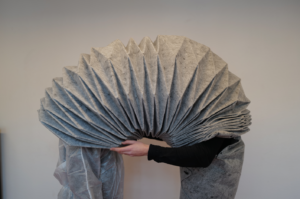
The instructions in the brain are translated into nerve signals to drive the hand muscles, and the hand muscle movements are again translated into electrical signals for input into the machine. The movement of the machine again generates signals through our eyes and transmits them to the brain, and the brain makes adjustments and the cycle repeats.
Fast or slow, this series of translations constitutes the communication between man and machine. The stronger this communication, the more the machine tends to become part of the human body.
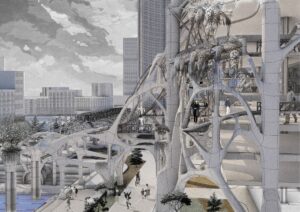
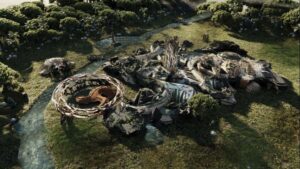
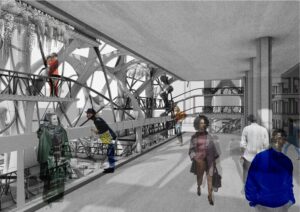
As an alternative strategy to the renovation of the Montparnasse center in Paris, this project explores the morphological potentials of stone structures rising from the existing multilayer ground infrastructure on site in order to create spatial interconnections between the street, the envelope, and the existing buildings. In this rehabilitation, the site is converted in order to integrate the existing infrastructure, and the surrounding context through the growth of a connective multilayer architecture.
PART 1 AND PART 2 UNCONDITIONALLY REVALIDATED!
THANK YOU TO RIBA
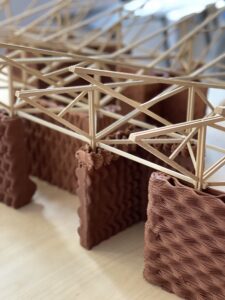
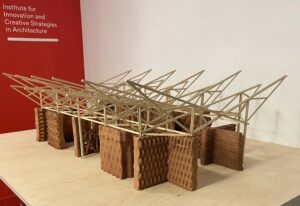
The project explores the innovative technique of 3D clay printing within the construction industry, blending digital design and ancient materials like clay to revolutionize architectural possibilities. This method promises efficiency through minimal waste, rapid construction, and automated processes. The process starts with creating a parametric design digitally, followed by prototyping to refine factors such as material liquidity, air pressure, and layer spacing. Through iterative testing, the project enhances control over the design and printing process, culminating in the construction of a model with a timber roof and multiple supporting walls. This exploration not only optimizes construction techniques but also expands design potential in architecture.
This semester, Juan Velasquez, an architect professor at CONFLUENCE, is leading two workshops, one at CONFLUENCE and another in Colombia in partnership with Exkema.
Exkema is an initiative that was conceived and established in 2004. Convinced of the imperative to generate positive and constructive changes in the field of architecture, the founders of Exkema embarked on a constant quest for innovation. Their unwavering belief in the transformative power of architecture has been the driving force that has guided them throughout their journey.
From its inception, Exkema has endeavored to be at the forefront of the industry. This relentless pursuit of novelty has led them to nurture creativity and explore new opportunities. Each project undertaken by Exkema is a reflection of their commitment to originality and excellence. By combining traditional expertise with innovative approaches, Exkema has pushed the boundaries of architectural design, creating spaces that exceed expectations.
Over the years, Exkema has established strong partnerships with professionals from various backgrounds, allowing them to diversify their areas of expertise. By collaborating with experts from different disciplines, Exkema has approached projects from multiple angles, integrating ideas from diverse sectors to enrich their creations.
At the core of Exkema’s mission lies a commitment to social and environmental innovation. In addition to pushing the boundaries of architectural design, Exkema constantly strives to create sustainable and eco-friendly spaces. Awareness of the importance of ecology guides every decision they make, from the choice of materials to the implementation of environmentally friendly technologies.
Thus, Exkema continues to stand out as a pioneer in contemporary architecture. Their legacy of innovation and excellence endures, shaping the future of the architecture industry and inspiring future generations to rethink the spaces of tomorrow.
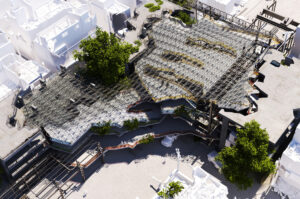
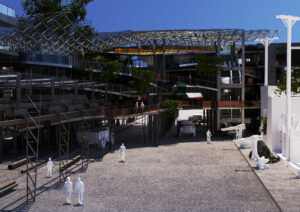
This project imagines a temporary structure being able to evolve over time and adapt to the use of people, where events centered on exchange and interaction would give life to a community-based social scene and help re-establish the city’s identity through the very people that inhabit it. The wounds caused by the war, visible on the urban fabric of the city, would be the starting point: what would normally be hidden and constructed upon, becomes instead the statement of a landmark that bridges future possibilities with the memory of what happened; taking from the negative volume of the destruction, a new place takes shape, where flexibility and experimentation can happen.
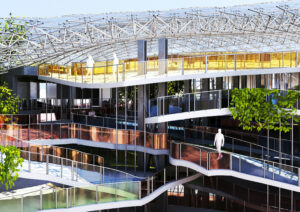
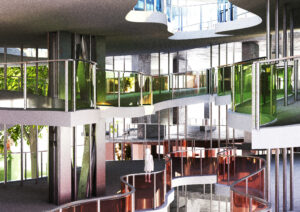
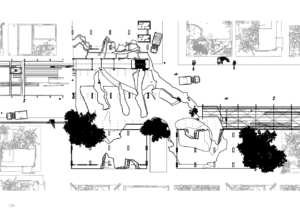
Igor Siddiqui (b. 1974 in Rijeka, Croatia) is an architect and associate professor at the University of Texas at Austin. He has served as a full-time faculty member at the School of Architecture since 2009, where he currently holds the Gene Edward Mikeska Endowed Chair for Design. Siddiqui’s practice, teaching, and research explore the relationship between design innovation and public engagement. He current projects examine the status of the interior in architecture and as a space of artistic collaboration.
Siddiqui frequently works with cultural organizations that support public art initiatives and projects. His work has been published and exhibited throughout the US and internationally. Siddiqui received his Master of Architecture from Yale University and a Bachelor of Architecture from Tulane University in New Orleans. He previously taught at the University of Pennsylvania, Parsons School of Design, and California College of the Arts and has a visiting professor at ENSA—Paris-Belleville and the Cranbrook Academy.
The lecture presents in-progress research centered on Claude Parent’s temporary installations—les praticables—designed between 1969 and 1975.
The purpose of these projects was to test Parent’s theory of the oblique function through public engagement and collaboration. Some of the designs were built, others are only known through existing models and drawings, and some are barely documented at all. Based on fragment of archival materials, nine of the installation designs are reconstructed through new digital drawings and models. As such, they can be examined not only individually but also as a series of design iterations that form a cohesive body of work, responsive to varying contexts and inextricably linked to the accompanying activities, artefacts, and narratives without which our understanding of them is incomplete. Fifty year later, these projects inspire new possibilities for conceptualizing design practice within and beyond architecture.
For several years he has been developing a photographic work that explores space and architecture as much as the medium itself.
He tries to record the real in a form of objectivity, reporting, by the frontality of his framings, a statement of the photographed places, as markings of history, politics and society, and as mental configuration.
His, is part of the history of documentary photography but alsoin a place that shows that the tool is never transparent, and that its own qualities, light and framings participate in the organization of this recorded reality.
CONFLUENCE invites Eric AUPOL for exploring new ways to express space and his perception of reality.

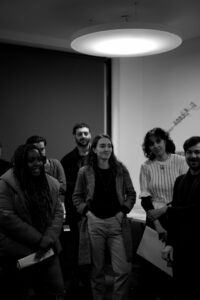
Mathieu BONARDET
Graduated from the Beaux-Arts of Paris in 2013, Mathieu BONARDET lives and work in Paris. He brings the drawing to other fields than what is defined by the space of the street.
His practice first led him to filmer or photographies actions before direction it to the volume.
Since then, his work has oscillated between drawing and sculpture which feed off each other and on graphite, answers steel.
After the closure of the Jean Brolly gallery, with which he collaborated for 7 years, he joined the ETC gallery in Paris.
CONFLUENCE invites Mathieu BONARDET for his mindset and pushing the limits of the drawing through materiality and space.
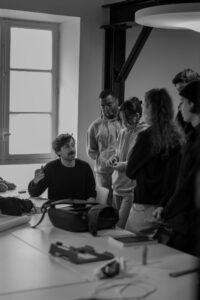
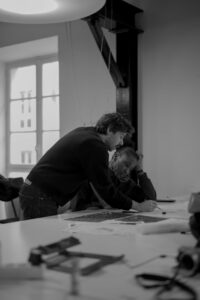
Mathieu BONARDET:
In Mathieu Bonardet’s work, draftsmanship centers around primary physical
action and material: drawing lines with graphite. These repetitive lines are
both corporeal and temporal inscriptions of the artist’s gesture. The tension
generated between two given elements – attraction, rejection, rupture,
distance, disparity – nourishes Bonardet’s work and gives body to his diptychs.
His drawing practice goes far beyond the confines of a sheet of paper: first
with filmed performance or photographic documentation of actions (notably
the photographic series Ligne(s), 2011 featured on the cover of Roven
in 2014, and later shown in the König gallery in Berlin in 2017, or Fracture II,
2015 acquisitioned by the FRAC Normandie Rouen) then moving to a three
dimensional practice. His work now moves between sculpture and drawing,
one nourishing the other, as graphite responds to steel and vice versa.
After the closing of the galerie Jean Brolly where Bonardet was represented
for over seven years, he now joins the galerie ETC.
For several years, I have been developing photographic work that explores space and architecture as much as the medium itself. I try to record reality in a form of objectivity, reporting, through the frontality of my framing, an observation of the places photographed, as markers of history, politics and society, and as mental configurations.
My work, which I will present during this conference, is part of the history of documentary photography, but also in a space which shows that the tool is never transparent, and that its own qualities, light and framing, participate in the organization of this recorded reality.
Eric Aupol:
Born in 1969 and based in Paris, Éric Aupol became known for his photographs relating to places and spaces as markings of History and as mental configurations. The expanses of the landscape, the constrictions of private or collective habitats, the details of objects, bodies and faces are approached in the quest for a visual writing where the sensitive and the intelligible would cease to oppose each other.
The margin, both historical, political and aesthetic, crosses at different levels of revelation the whole of his photographic corpus, questioning the spaces visited as much as the photographic medium, playing with what is obstructed and revealed to the gaze in the real, palimpsest of a leafing through of memories and history.
Winner of the Villa Medici outside the walls in 2009, represented by the Polaris gallery in Paris, he teaches photography at the National School of Art in Bourges, and intervenes in various art schools, in the form of workshops and conferences (ENSP Arles, ENSCI Paris, International Academy of Art Ramallah, University of Shanghai,…)
His work is present in many public and private collections, in France and abroad (National Library, European House of Photography, Heidelberg Museum, Erasmus University of Rotterdam,…)
CONFLUENCE is proud to be part of the STEM IS FEM movement.
STEM IS FEM is an educational project that promotes STEM specialties, science, technology, engineering and mathematics, among Ukrainian high school girls.
https://stemisfem.org/en/pro-proekt
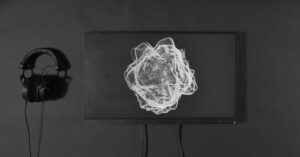
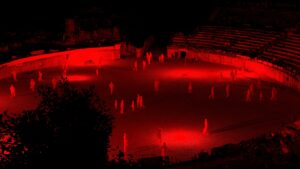
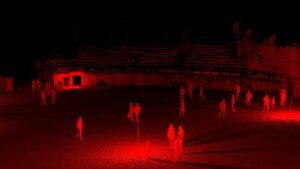
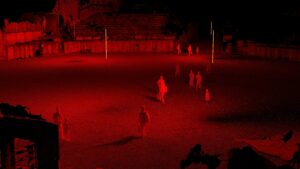
REDS
Student: Emma Miglietta
Tutor: Nathalie Junod Ponsard
altering the perception of the space through the emotional duality of red light and the two-dimensionality
that its shadow create.
Site: Arènes de Lutèce (2nd century CE), 49 rue Monge, 75005 Paris 53 x 47 m