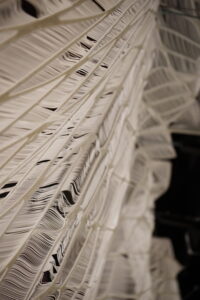


Intensive workshop with Andrea Blum
April 15th to April 19th 2019
Let’s imagine we could do it over again…………………………………………
What would you want your new world to look like?
How would you change the way you live?
How would you eat, dress, navigate, socialize?
How would you form your community?
Bugs & Birds / Flora & Fauna / When in Doubt Look to Nature
This workshop is dedicated to learning from an example: How we can use the model of another life
form/species to serve as a model for humans to rejuvenate how they live now, and how they will live on the Moon in the future?
Example: the spittlebug lives inside a cluster of bubbles; the sea spider gets oxygen through its pores; the hermit crab finds the right size shell for a home, and the bee builds communal architecture …
DESIGN DEVELOPMENT
Intensive workshop with Chandler Ahrens
The intensive one-week workshop focuses on advancing the Moon Village studio project lead by Tom Shaked and Aaron Sprecher. The goal is to advance the design to incorporate building systems that reinforce the architectural concept of each project.
The Moon Village project creates several difficult questions that must be addressed from technical issues to the quality of spaces for habitation. The workshop will focus on advancing the designs the initial designs to address issues of materiality, construction techniques, structure, air, water, light in addition to how people use the spaces for living. The architecture of space stations, space ships, and proposed long-term habitation require very tight integration of building systems with the use of the spaces. As with architecture on earth, building systems are the primary material to design with and must reinforce conceptual ideas.
The objective of the course is to develop innovative design strategies to that acknowledge that buildings are complex interrelationships of systems that must coalesce at multiple scales in relation to the architectural concept and comfort of the human body.
Design strategies must opportunistically negotiate and synthesize these complex relationships including structure, material behavior, solar heat gain, internal heat gains, heat loss through the façade, daylight levels, artificial lighting, ventilation, acoustics, and safety.
The complex interrelations of building systems that cannot fail require an integrative approach with the design concept.
Workshop with Romain Viricel, Designer
March 25th to March 29th, 2019
Since the dawn of time, Man has used, manufactured, and adapted to his environment to evolve and live in the latter.
35,000 years ago in the Jura Swabian, a group of Man pierced holes in a bird’s bone of a few centimeters, it is the birth of a flute, the birth of music.
When the man went into space, he created new objects or transformed existing ones, to respond to a new environment, a new need with other constraints.
The Space Pen, the Lunar Rover, the travel golden recorder, the falling astronaut, the dragon crew, when the engineers of the space X program development projects, they draw at the same time the evolution, the adaptability, think about the technologies to the ergonomics and manufacturing but also to dreams and craze
During this workshop week, students will have to rethink the use of an object or a piece of furniture for extra-terrestrial use.
Repeating either an earthed object adapted and redrawn for space or a fully imagined object responding to a new need. The final object will be built on a 1: 1 gray cardboard scale.
The semester studio projects will serve as background and environment for the objects drawn during this week of the workshop.
It will be necessary to pay particular attention to the drawing, to its lines, its form, its ergonomics, to the relation with the body but also, of course, to the new constraints of the environment.
After 5 years in Lyon, CONFLUENCE opens a new chapter in its history.
From September 2019, the school will be based in the center of Paris. and will continue its commitments: to further question the teaching of Architecture through an alternative pedagogy.
We have built together, a unique and singular training, a network of international contacts, and for each student, a personalized course that goes well beyond a professional education.
Establishing school in Paris is a new adventure and an important step in the development of CONFLUENCE. We would be happy to build future collaborations and continue to foster a new generation of architect together
{UN}BLINKING MACHINE, GYGES ‘ESCAPE
Smart technologies, smart cities… We are becoming the focal point of a global panopticon. In a world obsessed by our identities, how can we make a place for the outstanding?
Project by Maxime Baudoncq with distinction DIGITAL CULTURES
STATE OF NEGOTIATION
Project by Joséphine Bourat with distinction TECHNOLOGICAL SPECULATION
• Odile Decq, Architect and founder of CONFLUENCE, thesis advisor
• Aaron Sprecher, Architect, and Professor at Technion University in Tel Aviv
• Nicolas Hannequin, Architect, teacher and thesis advisor
• Lionel Lemire, Architect, and teacher at Ecole Spéciale d’Architecture
• Jacques Sautereau, Architect, urbanist, and teacher at CONFLUENCE
• Tom Shaked, a Ph.D. student at Technion University and a teacher at CONFLUENCE
• Charles Ober, Architect graduated from CONFLUENCE
• Domitille Roy, Architect graduated from CONFLUENCE
Key Dates for admission fall semester 2019
• Before March 15th / Application fees: 0 €
• Before May, 15th / Application fees: 100 €
• After May 15th / Application fees: 200 €
Why choose CONFLUENCE?
Based on an evolving and radical understanding of research, experimentation, and trans-disciplinarity, the Institute proposes:
• To construct an unparalleled understanding of architecture at the encounter of disciplines
• To cross prospective and experimental visions
• To create an appetite for engagement
• To generate unpredicted alternatives
• To resist the uniformization of production and imposed standards
• To go beyond the implicit limits of architecture, in order to create unimaginable opportunities.
CONFLUENCE is an educational approach that is open, alternative, international, collaborative and innovative, moving towards a hopeful and forward-looking architecture for the 21st century
Intensive workshop with Aaron Sprecher – February 15th to February 19th
Space inhabitation requires a new understanding of architecture and living conditions
Eating, sleeping, and working are here activities that take place in a singular spatial system while new forms of psychology are required in order to sustain life away from planet Earth.
This design studio comes to examine current intellectual and practical directions in the study of design for living in outer space.
The goal of the design studio will be to advance ideas in terms of populating space with a human community while exploring the advanced building and digital technologies. Our design team will collect the various proposals and create a new residential satellite for planet Earth.
Each team will choose a specific location on the moon. The team will report on the local features of this location, both in terms of resources and reachability. The second phase of our research will focus on the building of an architectural intervention using the fabrication principles developed in the previous workshop of Tom Shaked and Karen Lee Bar-Sinai.
From February 8th to February 15th, 2019
As part of “Moon Village ” studio, Tom Shaked and Karen Lee Bar-Sinai will teach an intensive workshop in order to explore the potential for ground-scaping of the lunar surface as a foundation for extraterrestrial architecture.
The advancements in robotic fabrication are bringing about new ways to craft materials.
In this context, robotic tools can help establish a long-lost art of ‘scaping’ earth-based matter through applying in-situ digital manufacturing to natural and remote terrains.
Thus, in the context of lunar construction, the robotic tool thus becomes a mediating link between the architect and the distant matter.
The workshop will explore this form of robotic scaping of large-scale environments through applying traditional craft techniques on the sand-based matter, and its shaping to the desired form using a hybrid of formative, subtractive and additive digital techniques.
An international team of teachers
CONFLUENCE Institute proposes to mobilize all its resources, to build a team of experts in the fields of architecture, robotics, design, virtual reality, anthropology, and digital manufacturing, to reflect during 15 weeks on the Moon Village project.
• Odile Decq, Architect, and founder of CONFLUENCE, France
• Jacques Rougerie, Architect, and a specialist in the speculative project, France
• Aaron Sprecher, Architect, and a specialist in digital fabrication, Israel
• Elisabeth Bacon, Researcher in cognitive psychopathology, France
• Chandler Ahrens, Architect, and a specialist in computational design, United States
• Tom Shaked, Architect, and a specialist in robotic, Israel
• Jacques Sautereau, Architect, France
• Romain Viricel, Designer, France
• Andrea Blum, Artist, United States
The school will develop a series of scenarios capable of addressing the issues raised by life in space. Organized around seminars and intensive workshops, this transversal experiment will use the full potential of architecture to question the key challenges of such a project:
• How to think of a new form of construction in space? > Robotic experimentation
• How to build with the material of the Moon itself? > 3D Print Experimentation
• How to design a remote-construction the process between the Earth and the Moon > VR Experimentation
• How to design interiors and objects out of gravity? > Experimentation design
• How to organize an “extra-terrestrial” collective life and the uses that accompany it? > Anthropological experimentation
These questions will converge in the architecture of the future Moon Village and will allow us to rethink more generally our way of living and building together.
2019 will mark the fiftieth anniversary of the first step on the moon.
At the same time, a large number of projects such as SpaceX, Moon Express, Google Xprize renew with the old dream of space conquest and mark a historic turning point in the evolution of humanity.
Space is undeniably our new frontier. And the Moon, the first base camp of our future migrations. Unlike the first lunar missions, it will no longer be a matter of staying there for a few hours, but of living there. It will not only be a question of exploration and staying there for a short time. It will decidedly a matter of settlement. To live together. Even if only temporarily before migrating towards new territories.
It is therefore important for us to imagine how to build the first human village out of Earth. A village that will not be reduced to its basic functional use but will demonstrate our capacity to transform the moon’s sterile environment into a new place of life, experimentation, tourism, research, education, art, and art. ‘architecture. CONFLUENCE Institute proposes to mobilize all its resources, to build a team of experts in the fields of architecture, robotics, design, virtual reality, anthropology, and digital manufacturing, to reflect during 15 weeks on the Moon Village project.
For the 2018 edition of the Festival of Lights, CONFLUENCE and the Bullukian Foundation team up once again to offer “Polyfolies”: a luminous installation created by students in architecture.
On the occasion of the studio “Create a material, create a light” organized at CONFLUENCE Insitute by Juan Velasquez, lighting architect, and Domitille Roy, architect, the students had to imagine and propose an innovative and relevant lighting installation. This installation aims to be a reflection of the pedagogy developed at CONFLUENCE: “Learning by doing: manufacturing and experimentation”.
Of the eleven projects presented, the jury, composed of Odile Decq-director of Confluence Institute, Nicolas Hannequin-teacher at Confluence, Fanny Robin-project manager at the Bullukian Foundation and Romain Tamayo-project manager at the Festival of Lights, has selected the winning project: “Polyfolies” proposed by Meriem Benkirane, a third-year student at CONFLUENCE
“It is the sea that comes back to us in this winter time. After crossing a narrow gate, we discover an illuminated courtyard. Petals are molded, deformed, multiplied to create this enchanting environment. Strident beams of light pass through the petals and dilute. Thanks to the strength of the wind, the reflection of the petals vibrates and undulates on the floor and facades of the courtyard. This mysterious light envelops us and our shadow mingles with multiple reflections.
Formerly intended to illustrate the wealth of its occupants, the court acted as theatrical scenery, place of representation and projection. This project proposes to stage the court of the Bullukian Foundation using the processes of enchantment. Sublimate the environment, shape reality and create an atmosphere where our emotions can ignite.”
Partners:
• IGuzzini
• La ville de Lyon
Intensive workshop with Charles Ober from September 29th to October 8th, 2019
At the heart of this collaborative project, students from the school of CONFLUENCE are led to the design and co-build space proposal. The project is based on the idea of “pioneers”: insects, plants, birds, which often in uninhabited territories are the only ones and first occupants. These pioneers are shaping the territory.
From this bio-mimetic parallel students will have to extract principles, processes, forms, methods from their observations on these pioneers. We will look at how, these principles, become spatial mechanisms, manufacturing processes, organization assembly methods, second skin, grafting…
At the heart of their experiments and research, students will establish a scenario for this unusual place.
At first, they will define the ecosystem of the project, make interactions between the different actors, the events, the neighborhood, and its inhabitants. But also, in a second time in the form of prototypes, manufacturing tests, constructive details …
More generally, during this workshop, we will examine the relationship between design techniques and manufacturing methods, and how they interrogate and inform each other.
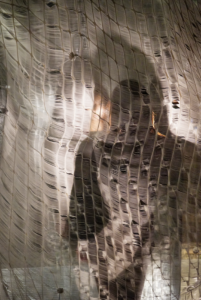
This Diploma work investigates integrating textile technologies in architecture to create responsive, dynamic spaces. It explores textiles’ role in the architectural fabrication process, utilizing digital tools and additive manufacturing. This involves experimenting with textile flexibility, strength, and its potential as a constructive element through various tests and practical applications. The research is framed within a hybrid theoretical and practice-based approach, pushing the boundaries of traditional architectural methods and concepts. Key case studies include developing permeable structures that adapt to changing environmental and social conditions. The outcome emphasizes textiles not just as materials but as integral, functional elements in building environments that are constantly evolving and adapting.